
What Is Circadian Rhythm and Why It Matters

What Is Circadian Rhythm and Why It Matters
Between 3 and 10% of your genes run on a 24-hour schedule. Not just your sleep. Your immune system, hormone levels, blood sugar, and the way your cells repair DNA — all of it follows a daily clock. Most people think circadian rhythm just means feeling sleepy at night. It’s far bigger than that. When the clock runs well, your body works as it should. When it goes off track — from shift work, late screens, or erratic meal times — the damage goes well beyond a bad night’s sleep.
Key Takeaways
- Your body clock controls 3–10% of all your genes — including metabolism, immunity, and hormone release (PMC9334736, 2022).
- Night-time bright light raises cardiometabolic death risk by 56–67% in a study of 88,905 people (PNAS, 2024).
- Over 50% of people experience “social jet lag” — when your body clock and your social life don’t match.
- Simple tools — morning light, a sleep protocol, and wearable devices — can measurably realign your clock.
What Is Circadian Rhythm? How Your Body Clock Actually Works
Your circadian rhythm is your body’s internal 24-hour clock. Research confirms that 3–10% of your genes switch on and off based on the time of day — including the genes that control sugar burning, fat metabolism, and cholesterol production (PMC9334736, 2022).
The clock is run by a tiny cluster of about 20,000 brain cells called the SCN (suprachiasmatic nucleus). Think of it as your master pacemaker. It sits in the hypothalamus. It receives light signals from your eyes and sends timing signals to every organ in your body.
The clock runs on four key genes: CLOCK and BMAL1 switch the cycle on each morning. PER and CRY proteins build up through the day. When they reach a high enough level, they switch CLOCK and BMAL1 off. Then the whole cycle resets. It takes about 24 hours to complete.
Light is the most powerful signal your clock uses. Other signals include meal timing, exercise, and temperature. But light is the most important one. Understanding light’s effect on circadian rhythm is the single best starting point for fixing your clock.
What Happens to Your Health When Circadian Rhythm Is Disrupted?
When your clock runs out of sync, the effects reach every system in your body.
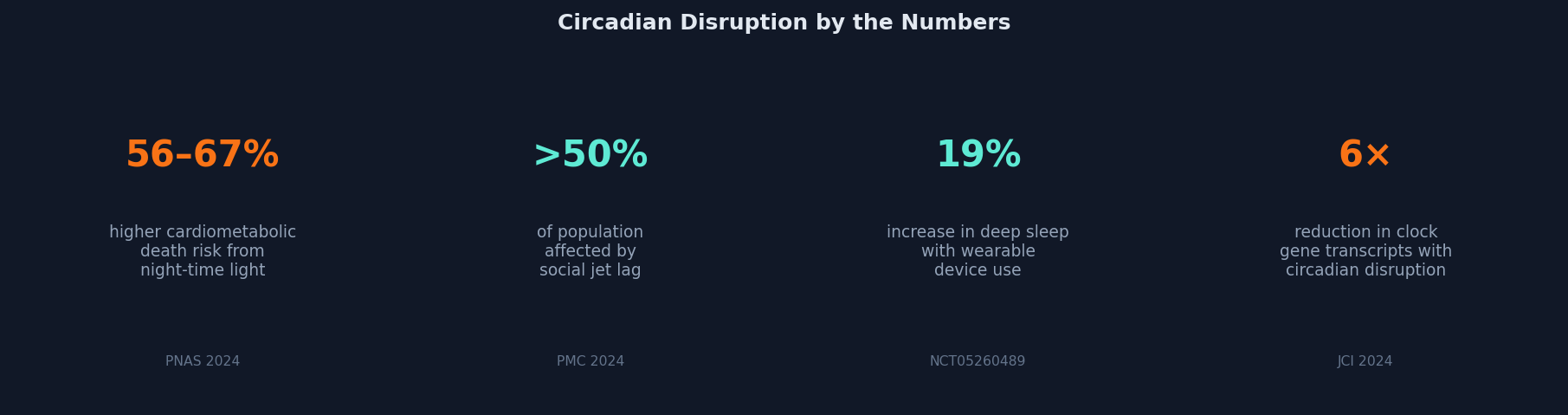
A 2024 study in the Journal of Clinical Investigation found that circadian disruption lowers your resting metabolic rate. It also raises blood sugar — both when you’re fasting and after meals. Clock gene activity dropped up to 6 times compared with normal sleep timing. That means your metabolic machinery is running at a fraction of what it should be.
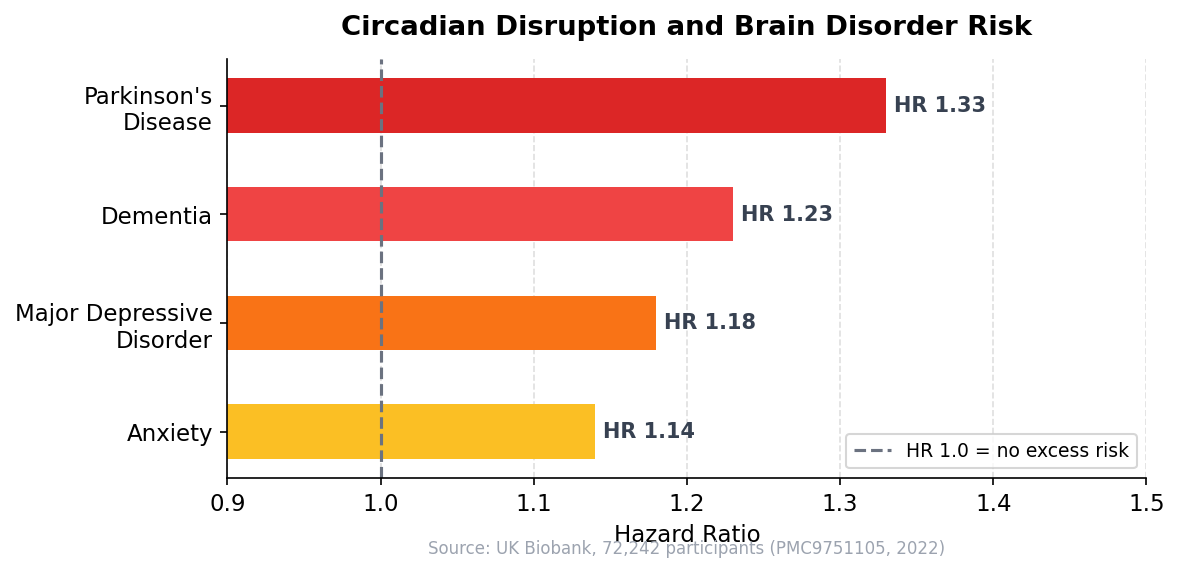
The brain effects are just as serious. A study of 72,242 UK Biobank participants found that a weaker circadian rhythm raised the risk of several brain conditions (PMC9751105, 2022). Anxiety risk went up by 14%. Major depression risk went up by 18%. The risk kept climbing for more serious conditions — dementia by 23% and Parkinson’s disease by 33%.
Heart health follows the same pattern. A 2025 review found that every five extra years of shift work raises cardiovascular disease risk by 5–7% and stroke risk by 4% (PMC12384635, 2025). The WHO’s cancer research arm (IARC) classifies night shift work as a probable carcinogen — the same category as red meat (IARC/WHO, 2019).
Between 15 and 27% of workers in developed countries do shift work (PMC12384635, 2025). That’s tens of millions of people quietly building up health risk, year after year.
How Does Light Control Your Circadian Rhythm?
Light is the most powerful signal your body clock uses. A landmark 2001 study found that switching from dim light to bright light first thing in the morning raises cortisol (your wake-up hormone) by more than 50% immediately. Afternoon light had no effect on cortisol at all. Timing is everything.
Another study put numbers on it. 800 lux of morning light produced 35% higher cortisol levels at 20 and 40 minutes after waking compared with waking in darkness (PMC3413982, 2012). Higher morning cortisol means better alertness, faster metabolism, and a stronger immune response through the day.
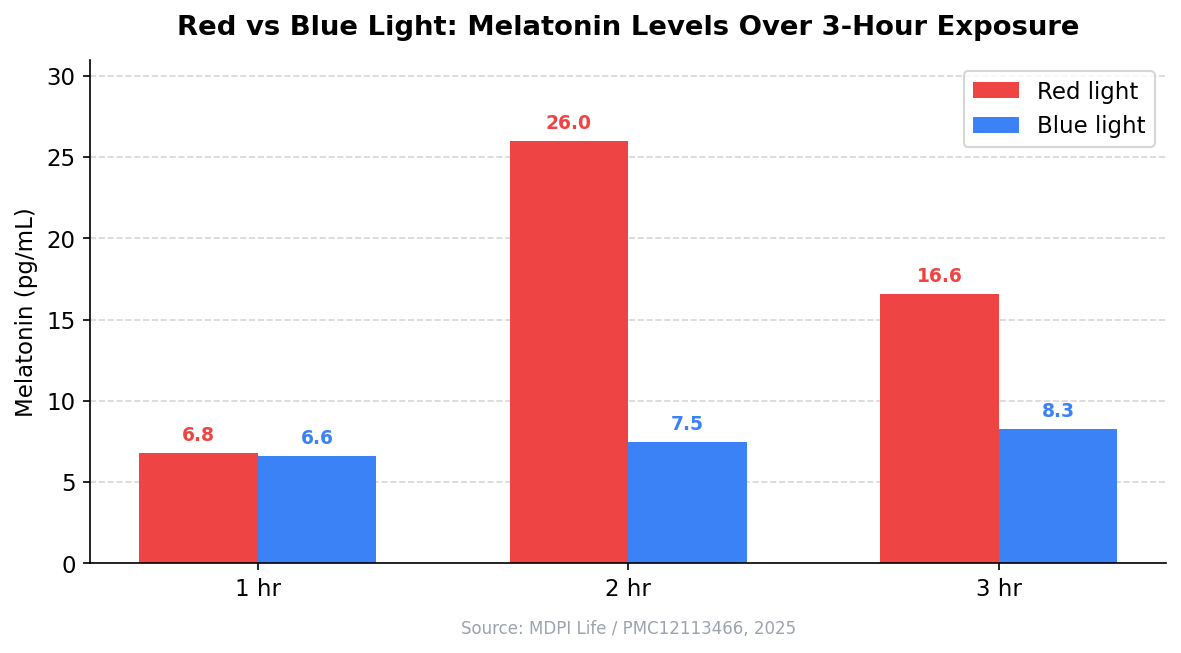
Evening light works the opposite way. Blue light from screens and LED lights suppresses melatonin — your sleep hormone. A 2025 study measured this directly. After two hours of blue light exposure, melatonin dropped to just 7.5 pg/mL. Under red light, it stayed at 26.0 pg/mL — a 3.5x difference (MDPI Life / PMC12113466, 2025).
Blue light also suppresses melatonin for twice as long as green light. And it shifts your clock twice as far — 3 hours versus 1.5 hours.
Worth sitting with: At the 2-hour mark, blue light doesn’t just slow melatonin production — it switches it off. 7.5 pg/mL is near baseline. Your body thinks it’s still mid-afternoon. If you watch TV or use a laptop for two hours before bed, this is what’s happening inside your body.
Changing your evening light source makes a real difference. Red light therapy for circadian rhythm lets you keep evening light exposure without triggering the melatonin-suppressing pathway. For screen use, blue light blocking glasses are a simple first step — most people can start using them tonight.
What Is Social Jet Lag, and Why Does Your Weekend Sleep Pattern Matter?
Over 50% of people in 24-hour societies experience social jet lag (PMC11689739, 2024). Social jet lag is the gap between when your body wants to sleep and when your schedule forces you to sleep. Going to bed at midnight on weekdays and 2 am on weekends — that two-hour shift is like flying to Riyadh and back every Friday.
Among adults aged 50–83, 49% had measurable social jet lag in the same study. It raised depression scores and lowered cognitive performance — even when people slept enough total hours. You can get 8 hours of sleep and still suffer the cognitive cost if the timing is off.
The reason is simple. Your SCN expects light and activity cues at the same time every day. Shift the weekend cues by even 90 minutes and the clock genes take several days to re-sync. For most people, they haven’t fully re-synced before Monday arrives. Then the cycle starts again.
How to Reset and Protect Your Circadian Rhythm
Getting your clock back on track isn’t complicated. It takes deliberate daily choices. Wearable circadian research grew from 1 study in 2014 to 34 studies by 2025 (Chronobiology in Medicine, 2025). The tools have arrived. Here’s how to use them.
Morning Light
Get bright light into your eyes within 60 minutes of waking. Target 800–1,000 lux — achievable outdoors even on an overcast day. 800 lux at wake produces 35% higher cortisol at 20 and 40 minutes post-wake compared with dark conditions (PMC3413982, 2012). That cortisol spike sets your biological anchor for the entire day.
Consistency matters more than intensity. Your SCN responds to predictable cues. Light at 7 am every day — seven days a week — is more effective than occasional intense exposure followed by weekend lie-ins.
Evening Light Management
After sunset, cut short-wavelength blue light and protect your melatonin rise. Dim your overhead lights. Switch to warm-spectrum bulbs. Keep screens at arm’s length. For those who can’t avoid screens, blue light blocking glasses filter the most disruptive wavelengths — especially the amber-lens versions.
From our experience: At Holosophy, clients who pair morning light (an outdoor walk in the first hour after waking) with amber glasses from 9 pm consistently report shorter time to fall asleep within two weeks. Light timing is the first thing we address — because it resets the entire hormonal chain that follows.
Evening is also a good time for red light. Red wavelengths (630–850 nm) don’t suppress melatonin the same way blue light does. Red light panels are a genuinely clock-safe option for evening use at home.
Structured Sleep Protocols
Consistent sleep and wake times are non-negotiable. A circadian-optimized sleep protocol goes beyond “go to bed at the same time.” It sequences light, meal timing, temperature, and wind-down habits to reinforce the same daily signals. The goal is to close the gap between your social schedule and your body clock to under 30 minutes.
Wearable Devices
Wearables are now a serious tool for tracking circadian health. A one-year change in a wearable-derived circadian score is linked to an 8–12% change in overall mortality risk (Chronobiology in Medicine, 2025). You can now measure how well your clock is running.
For direct sleep improvement, Apollo Neuro for circadian regulation (NCT05260489, 500+ participants) showed that using the device 3+ hours per day, 5+ days per week was linked to a 19% increase in deep sleep, 14% more REM sleep, and 11% higher HRV. Note: this is company-funded observational data, not an independent trial. But the effect sizes align with what vibration-based autonomic regulation research shows.
Frequently Asked Questions About Circadian Rhythm
What time does the circadian rhythm reset?
Your clock re-anchors to the same time each day when the light cue is consistent. The strongest reset window is in the first two hours after waking. Bright light during this window locks in the clock. Shift the light cue by an hour and the clock follows — but it takes 2–3 days to fully catch up (Journal of Clinical Endocrinology & Metabolism, 2001).
Can you fix a disrupted circadian rhythm?
Yes — and faster than most people expect. The most effective approach combines a consistent wake time (no matter what day it is), bright morning light within 60 minutes of waking, and reduced blue light after sunset. Most people notice better sleep onset within one to two weeks. For serious disruption like jet lag or shift work, structured light therapy can speed up recovery by several days.
Does circadian rhythm affect weight?
Yes — strongly. Circadian disruption lowers your resting metabolic rate and raises blood sugar levels (Journal of Clinical Investigation, 2024). The clock genes that control fat burning and sugar metabolism run on a 24-hour schedule. Eating late at night — when your metabolic clock is in storage mode — raises body fat even when total calories are the same. Meal timing is itself a clock signal.
What is the best light for circadian rhythm?
It depends on the time of day. In the morning: bright, broad-spectrum light of 800–1,000 lux or more. Natural daylight is ideal. In the evening: warm-spectrum or red-wavelength light that doesn’t suppress melatonin. After two hours of blue light exposure, melatonin drops to 7.5 pg/mL. Under red light, it stays at 26.0 pg/mL (MDPI Life / PMC12113466, 2025). That gap matters.
How does circadian rhythm affect mental health?
The evidence is strong. A weaker body clock is linked to 14% higher anxiety risk and 18% higher depression risk in 72,242 UK Biobank participants (PMC9751105, 2022). Social jet lag independently raises depression scores even when total sleep is fine (PMC11689739, 2024). And night-time bright light exposure raised cardiometabolic death risk by 56–67% in a study of 88,905 people (PNAS, 2024). Fixing your clock is one of the most evidence-backed mental health steps you can take.
Conclusion: Your Clock Is Running. Is It Running on Time?
Your circadian rhythm isn’t just a sleep concept. It’s a timing system that controls your metabolism, hormones, immune function, and long-term risk of heart disease, brain disease, and cancer. The tools to protect it are simple and accessible. They just require consistency.
- Morning bright light (800+ lux in the first hour after waking) is the single most effective habit for anchoring your clock.
- Evening blue light can cut melatonin by 3.5x compared with red light. Managing your light environment after dark is not optional if sleep quality matters to you.
- Social jet lag affects over 50% of people and carries real costs to mood, thinking, and metabolism — beyond just feeling tired.
If you’re ready to take a structured approach, our circadian-optimized sleep protocol covers light, timing, temperature, and tools in a sequenced plan we use with Holosophy members.
Medical disclaimer: This article is for educational purposes only and does not constitute medical advice. Consult a qualified healthcare professional before making any changes to your sleep or health routine.